


Research groups
Websites
-
Kavli Institute for Nanoscience Discovery
Research centre
Collaborators
-
Vladyslav Vyazovskiy
Professor of Sleep Physiology
-
Mark Hankins
Professor of Visual Neuroscience
-
Simon Kyle
Professor of Experimental and Clinical Sleep Research
-
Jason Lerch
Professor of Neuroscience
-
David Bannerman
Professor of Behavioural Neuroscience
-
Russell Foster
Head of the Nuffield Laboratory of Ophthalmology and the Sleep and Circadian Neuroscience Institute
-
Aarti Jagannath
Associate Professor
-
Zameel Cader
Director of the Oxford Headache Centre and Director of StemBANCC

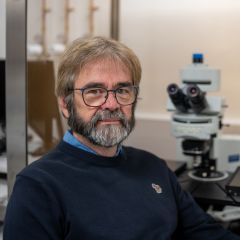






Stuart Peirson
BSc, PhD
Professor of Circadian Neuroscience
Circadian Neuroscience
Research Summary
My research focuses on how light regulates physiology and behaviour, with a particular interest in how our modern artificial light environment may disrupt these processes. The retina contains photoreceptors that mediate the tasks of vision as well the regulation of circadian rhythms, sleep and alertness. The central aim of my work is to understand how light information is transmitted from photoreceptor to brain to drive these responses. Research in my lab depends upon molecular biology and genomics, as well as optogenetics and chemogenetics. We also study behavioural responses including circadian rhythms, sleep and cognitive function. Photobiology, statistics and bioinformatics critically underpin our work.
Sources of Funding
Biography
I am Professor of Circadian Neuroscience and Group Leader in the fundamental neuroscience theme of the Sleep and Circadian Neuroscience Institution (SCNi). After completing my PhD in Neuroscience at the Institute of Ophthalmology UCL I moved to Imperial College to work as a postdoc. During this time I also acted as technical supervisor for the quantitative real-time PCR (qPCR) facility at Charing Cross Hospital. During my subsequent work, I contributed to the identification of the melanopsin pRGC system in humans as well as the characterisation of melanopsin signalling pathways. I was appointed as a Lecturer at Imperial College in 2005 before moving to the University of Oxford in 2006. My work has continued to focus upon characterising the signalling pathways mediating the effects of light on physiology and behaviour, with the aim of identifying novel targets for the regulation of circadian rhythms and sleep.
Key publications
Recommendations for measuring and standardizing light for laboratory mammals to improve welfare and reproducibility in animal research
Journal article
Lucas RJ. et al, (2024), PLOS Biology, 22, e3002535 - e3002535
Dim light in the evening causes coordinated realignment of circadian rhythms, sleep, and short-term memory
Journal article
Tam SKE. et al, (2021), Proceedings of the National Academy of Sciences, 118
Meta-analysis of transcriptomic datasets identifies genes enriched in the mammalian circadian pacemaker
Journal article
Brown LA. et al, (2017), Nucleic Acids Research, 45, 9860 - 9873
Melanopsin Regulates Both Sleep-Promoting and Arousal-Promoting Responses to Light
Journal article
Pilorz V. et al, (2016), PLOS Biology, 14, e1002482 - e1002482
Isoforms of Melanopsin Mediate Different Behavioral Responses to Light
Journal article
Jagannath A. et al, (2015), Current Biology, 25, 2430 - 2434
The CRTC1-SIK1 Pathway Regulates Entrainment of the Circadian Clock
Journal article
Jagannath A. et al, (2013), Cell, 154, 1100 - 1111
Recent publications
Molecular correlates of sleep deprivation in the mouse brain identified by meta-analysis of microarray data
Journal article
Abdalla OHMH. et al, (2026), Neurobiology of Sleep and Circadian Rhythms, 21
Simulated natural daylight and twilight modulate activity and light sampling behaviour in mice
Journal article
Steel LCE. et al, (2026), BMC Biology, 24
Analgesia through FKBP51 inhibition at disease onset confers lasting relief from sensory and emotional chronic pain symptoms
Journal article
Hestehave S. et al, (2025), Proceedings of the National Academy of Sciences, 122
Optogenetic vision restoration in the face of secondary and tertiary remodeling in the rd1 mouse retina
Journal article
Hughes S. et al, (2025), Molecular Therapy, 33, 5840 - 5859
Advocating for automation in animal research: using home cage monitoring to advance welfare, reproducibility and scientific openness
Journal article
(2025), Disease Models & Mechanisms, 18
Hypotheses in light detection by vertebrate ancient opsin in the bird brain
Journal article
Stevenson TJ. et al, (2025), Journal of Neuroendocrinology, 37
Deficient synaptic neurotransmission results in a persistent sleep-like cortical activity across vigilance states in mice
Journal article
Guillaumin MCC. et al, (2025), Current Biology, 35, 1716 - 1729.e3
Enhanced restoration of visual code after targeting ON bipolar cells compared with retinal ganglion cells with optogenetic therapy
Journal article
Rodgers J. et al, (2025), Molecular Therapy, 33, 1264 - 1281
Evaluation of the Digital Ventilated Cage® system for circadian phenotyping
Journal article
Tir S. et al, (2025), Scientific Reports, 15
The SnackerTracker: A novel home-cage monitoring device for measuring food-intake and food-seeking behaviour in mice.
Journal article
Mueller M. et al, (2025), Wellcome Open Res, 10
Rodent Toolbox v2.xlsx
- Rodent Toolbox v2.xlsx
- Microsoft Office - Spreadsheet 140.2 KB